October 27,
2008 NYTIMES
Art Review | Mark Rothko and Ammi Phillips
Yankee Spirit in Disparate Masters
By KEN
JOHNSON
Comparisons
may be invidious, but they can also be illuminating. Consider the small,
tightly focused exhibition of works by Mark Rothko and the 19th-century
American folk artist Ammi Phillips at the American
Folk Art Museum.
On
the face of it this is a stretch. Phillips, a prolific itinerant portraitist
active in New England between 1811 and 1865, was a self-taught neo-Classical
realist, a kind of folk-art Ingres. His figures are simplified and flattened,
but their faces are so sensitively drawn that they seem like real individuals
and not just the generalized types that the subjects of folk portraiture often
seem.
 Rothko, who emigrated from Russia to the United States
as a boy in 1913, was an intellectual omnivore. He attended Yale and studied
briefly in New York with the Modernist painter Max Weber. In the 1940s and
’50s, along with artists like Jackson Pollock, Willem de Kooning and Clyfford
Still, Rothko pushed abstract painting to unprecedented formal extremes. His
signature canvases, in which large, fuzzy-edged rectangles of color are
arranged in mysterious hovering stacks, would seem to be far from Phillips’s
earthbound portraiture.
Rothko, who emigrated from Russia to the United States
as a boy in 1913, was an intellectual omnivore. He attended Yale and studied
briefly in New York with the Modernist painter Max Weber. In the 1940s and
’50s, along with artists like Jackson Pollock, Willem de Kooning and Clyfford
Still, Rothko pushed abstract painting to unprecedented formal extremes. His
signature canvases, in which large, fuzzy-edged rectangles of color are
arranged in mysterious hovering stacks, would seem to be far from Phillips’s
earthbound portraiture.
As
organized by the museum’s senior curator, Stacy C. Hollander, the exhibition
nonetheless reveals parallel ways of dealing with surface, color and light.
Both painters favored broad flat areas of color, and Ms. Hollander has
underlined that connection by selecting paintings by both artists that feature
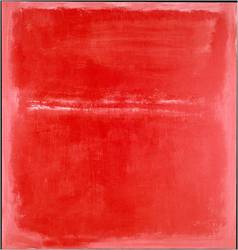
red, pink and green. An untitled 1970 composition of bright-red soft-edged
rectangles by Rothko echoes the red dresses worn by children in several
paintings by Phillips.
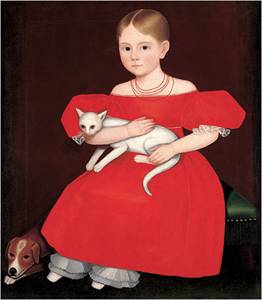 (Comparisons aside, Phillips’s painting of a girl in a
red dress holding a white cat is heartbreakingly lovely.)
(Comparisons aside, Phillips’s painting of a girl in a
red dress holding a white cat is heartbreakingly lovely.)
Some
of Phillips’s paintings have velvety dark backgrounds that rhyme with the big
nearly black, green square in Rothko’s “No. 1” from 1961. And the soft, misty
colors in Phillips’s portrait of Harriet Campbell, wearing a pale-pink
ankle-length dress and standing against a beige background, evinces a subtlety
of light and shade that reflects luminous parts of Rothko’s paintings.
More
intriguing than these formal parallels, however, is a question that Ms.
Hollander does not address: that of national identity. Each painter is, in his
own way, a distinctly American artist.
In
his 1955 essay “ ‘American-Type’ Painting,’ ” the critic Clement
Greenberg lauded the painters identified with Abstract Expressionism, including
Rothko, for their bold assertion of the elemental properties of painting, which
is to say, its flatness, color and shape.
Greenberg
was talking about the mid-20th-century vanguard, but he might also have been
describing Phillips, whose paintings similarly have a pragmatic, Yankee economy
of means and style.
American-type
painting is not fancy painting. It avoids the slick technique and showy
gimmickry of academically overtrained European painters.
Yet
there is, too, in both painters, a metaphysical dimension, which the archformalist Greenberg ignored. Rothko’s painted surfaces
give way to ambiguous, illusory depths implying ethereal realms of mind and
space. Phillips’s portraits have a timeless, ghostly quality; they’re like
pictures of undying, archetypal souls. This direct connection between the
terrestrial and the transcendental, unmediated by complicated symbolism, is
also in the American grain.
“The
Seduction of Light” runs through March 29 at the American Folk Art Museum, 45
West 53rd Street, Manhattan; (212) 265-1040, folkartmuseum.org.