I will let D(t) be the distance traveled after t seconds:
and V(t) be the velocity at t seconds. I'm looking for V(1).
I know that I have to divide distance by time to find velocity, so
I'll find D(1) first.
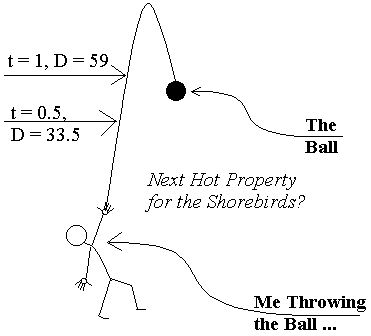
D(1) = -16 (1)2 + 75 (1) = 59 feet. (This has been added
to my picture.)
At first, I thought that this would give the velocity: 59 feet / 1
second = 59 feet per second. But after talking to Kyle, I realized that
the ball is slowing down, and this is only an average of the velocity so
far. To get a more accurate average, I can look at the time interval from
0.5 second to 1 second.
D(0.5) = 33.5 feet, and this has been added to my picture. So from
0.5 sec. to 1 sec., the ball travels 59 feet - 33.5 feet = 25.5 feet, and
averages 25.5 feet / 0.5 seconds = 51 feet per second in the time interval
from 0.5 to 1 second.
After I made this estimate, I realized that what I have to do is find
out what happens to this average velocity on smaller and smaller intervals
close to 1 second. I need to find a limiting value, or limit, (as t gets
closer to 1) for the average velocity:
This is where I get stuck. Do I have to find the average velocity for every interval close to 1 second? Is there an easy step that I missed?